


Diamond Cut
What Is The Cut Of A Diamond?
Diamond cut refers to how well-proportioned the dimensions of a diamond are and how its surfaces, or facets, are positioned to create sparkle and brilliance. There are several different cuts of diamonds, each describing the quality of the gem’s faceting, symmetry, proportion and polish. The higher a diamond cut rating, the better that gem’s light performance and symmetry.
Different diamond shapes will have their own ideal faceting and proportions, with balance and brilliance as the most important elements of all diamond cuts. The better cuts of diamonds will have the best light performance, with impressive sparkle and shine.
A diamond’s cut has the biggest impact on its sparkle, with many facets playing into how well-proportioned a diamond is. Explore our guide to learn more about the different types of diamond cuts, diamond anatomy, the diamond cut chart, GIA diamond cut ratings and how these all impact the price of a diamond.
The Most Important Of The 4Cs: Diamond Cut
When it comes to the famous 4Cs of diamonds, cut is considered the most important of them all. This is because a diamond’s cut can impact its beauty, its brilliance and even how large it appears when worn in jewelry such as engagement rings. The different cuts of diamonds each have their own impact on a gem’s appearance, with higher-quality cuts making diamonds look their very best.
So whether you’re buying natural or lab grown diamonds, we recommend aiming for the best diamond cut grade your budget allows.
Are You Looking For The Best Diamond Cut? It All Starts With Your Budget
No single diamond is perfect for everyone—but all of our customers, whether they’re eyeing a .50-carat or a 16-carat diamond, want as much sparkle as their budget allows. Of the the 4Cs (cut, color, clarity, carat), cut has the greatest influence on a diamond’s beauty and sparkle. Even a diamond with a flawless clarity grade (no blemishes or inclusions) can look glassy or dull if the cut is too shallow or deep. So, when determining what diamond to buy, go with the best cut grade that you can afford.
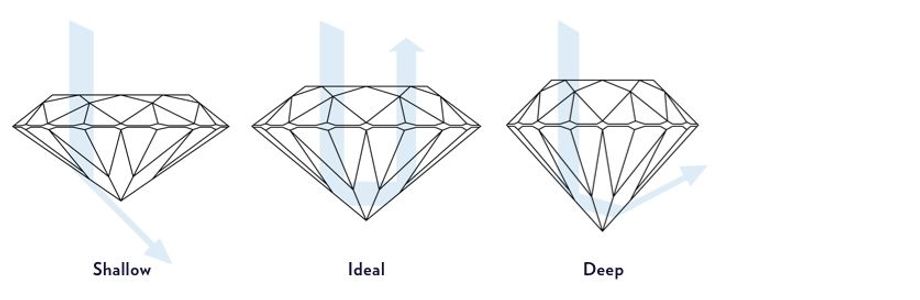
Blue Nile Offers Four Different Types of Diamond Cuts
Ideal: This rare cut represents roughly the top 3% of diamond cut quality. It reflects most of the light that enters the diamond.
Very Good: This cut represents roughly the top 15% of diamond cut quality. It reflects nearly as much light as the ideal cut, but for a lower price.
Good: This cut represents roughly the top 25% of diamond cut quality. It reflects most of the light that enters, but not as much as a Very Good cut grade.
Astor by Blue Nile™: These diamonds are crafted to gather and reflect the most light possible. Cut from the finest raw material (rough stones with as few impurities or inclusions as possible), they meet rigorous quality requirements and exhibit outstanding brilliance, fire, and scintillation. In addition to being graded by the GIA, all Astor by Blue Nile™ diamonds are certified by GemEx®
Blue Nile Does Not Sell "Fair" Or "Poor" Diamond Cuts
While 35% of the diamond market is made up of fair or poor cuts, Blue Nile does not offer them. Diamonds with low cut grades often appear glassy or dull, or just plain small, and they don’t live up to our standards of great quality at a great value.
The "Ideal" Cut Grade At Blue Nile Is The Same As The "Excellent" Cut Grade Rating By The GIA
Blue Nile uses the term Ideal while the GIA uses the term Excellent for the highest cut grade in round brilliant diamonds. These two words are interchangeable to represent the cutting style, proportions, and finish necessary to bring out a diamond’s sparkle, brilliance, and beauty.
While the diamond industry has long-standing proportion combinations that optimize light performance, only round brilliant cut diamonds have cut parameters established by the GIA. Blue Nile estimates and assigns cut grade standards for non-round (fancy shaped) diamonds based on their table and depth percentages.
The Characteristics Of A Well-Cut Diamond Are Superior Brilliance, Fire, And Scintillation
Brilliance relates to the reflection of white light
Fire is the dispersion of light into the colors of the rainbow
Scintillation is the play of contrast between dark and light areas—it’s the sparkle
The Anatomy Of A Diamond:
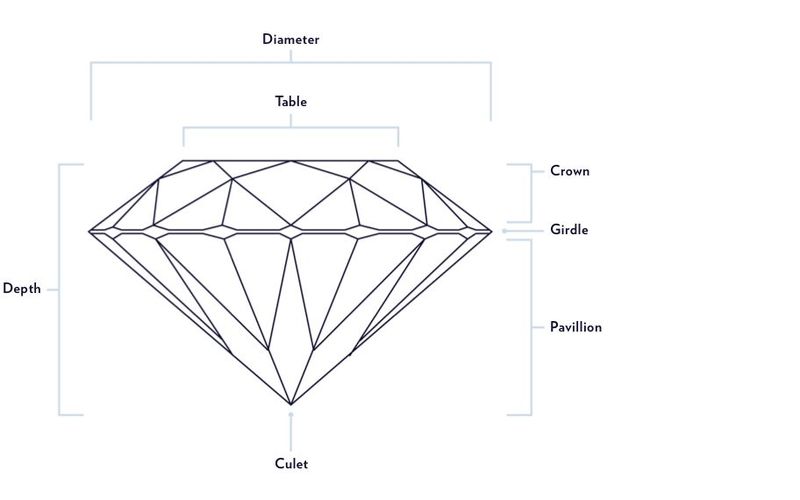
The different parts of a diamond all play into its cut and sparkle. These are the main components that influence the different cuts of diamonds.
Table: The largest facet of a gemstone
Crown: The top portion of a diamond extending from the girdle to the table
Girdle: The intersection of the crown and pavilion which defines the circumference of a diamond
Diameter: The measurement from one girdle edge of a diamond straight across to the opposing side
Pavilion: The bottom portion of a diamond, extending from the girdle to the culet
Culet: The facet at the tip of a gemstone. The preferred culet is not visible with the unaided eye (graded "none" or "small")
Depth: The height of a gemstone measured from the culet to the table
Diamond Cut And Diamond Shape Are Not The Same Thing
Although these terms are sometimes used interchangeably, diamond cut, and diamond shape mean different things.
Diamond cut assesses light performance of a diamond and is based on a combination of factors: proportions, symmetry, and polish (the overall surface condition of a diamond’s facets).
Diamond shape is related to the outline of a diamond. While the round brilliant diamond is our most popular shape, we also offer nine non-round fancy-shaped diamonds that can save you up to 25.
What Is The Most Expensive Cut Of A Diamond?
When people talk about someone’s engagement ring, everyone focuses on carat. In reality, it’s the cut of the diamond that can be the biggest factor in the price tag. The Ideal cut diamond, and the super-ideal Astor by Blue Nile™, are the most expensive diamond cuts because they optimize light performance and create the most impressive sparkle.
Every Loose Diamond At Blue Nile Has A Diamond Certificate
Our loose diamonds are accompanied by certificates and grading reports for their most important qualities. The most popular diamond grading institutions are IGI and GIA.
Diamonds that are accompanied by grading reports are the most highly valued in the industry. Every loose diamond at Blue Nile has been analyzed and graded by respected diamond institutions. You’ll find a diamond certificate on every diamond's detail page.
Diamond Light Performance Is Measured By The GemEx BrillianceScope® Analyzer
Two diamonds cut with optimal proportions won’t necessarily have the exact same light performance or beauty. For this reason, true light performance is measured by the GemEx BrillianceScope® Analyzer, a patented system that uses spectrophotometer technology to compare diamonds with the same shape.
Popular Diamond Cut Styles
While there are specific GIA and IGI ratings for diamond cut quality, the term can also refer to specific faceting styles. You’ll see this with terms such as step-cut diamonds or brilliant-cut diamonds. For these instances, the terms about diamond cuts refer to the faceting technique and what it highlights in a gem.
Step-Cut Diamonds are diamonds that are faceted with rectangular angles that highlight the gem’s shape and its glow. Popular step-cuts include emerald cut diamonds, Asscher cut diamonds and baguette diamonds.
Brilliant-Cut Diamonds are diamonds that are faceted for the most sparkle and fire. They typically have more facets than step-cut diamonds. Popular brilliant-cut diamonds include round diamonds, cushion cut diamonds and princess diamonds. Elongated diamonds with brilliant cuts, such as marquise diamonds, radiant diamonds and oval diamonds, are considered modified brilliant-cut diamonds.
Finding the Best Diamond Cut
With so many types of diamond cuts, ratings and factors, there are many ways to find the perfect fit for your purchase. You can browse our wide array of loose diamonds for sale and sort by diamond cut. Our experts are also available to help you explore the different diamond cuts. Visit one of our nearby jewelry stores or schedule a virtual jewelry shopping appointment to get started.
Have A Question?
Contact us by phone at 1-800-242-2728 or email at service@bluenile.com.
In addition, Live Chat is available during most business hours.