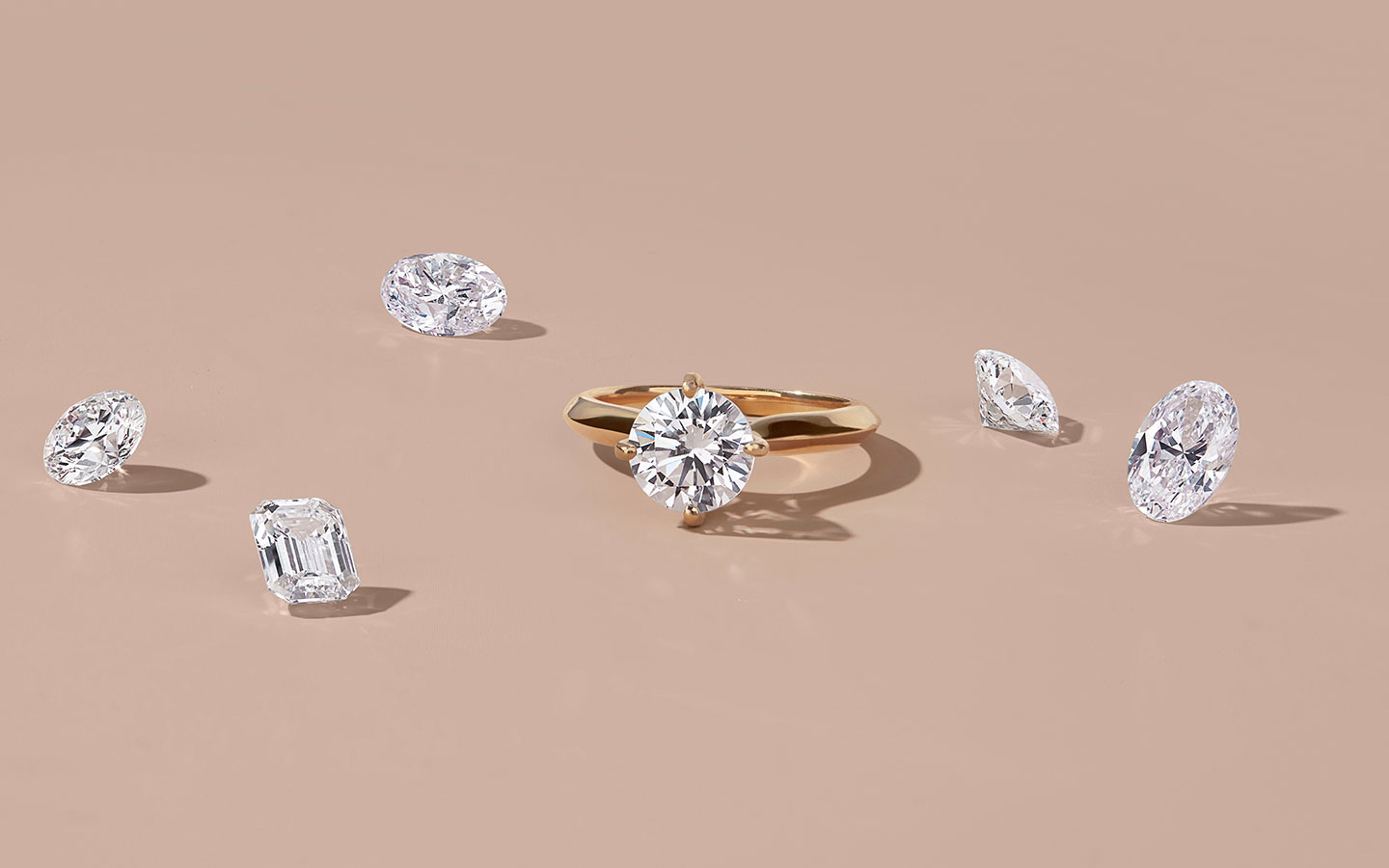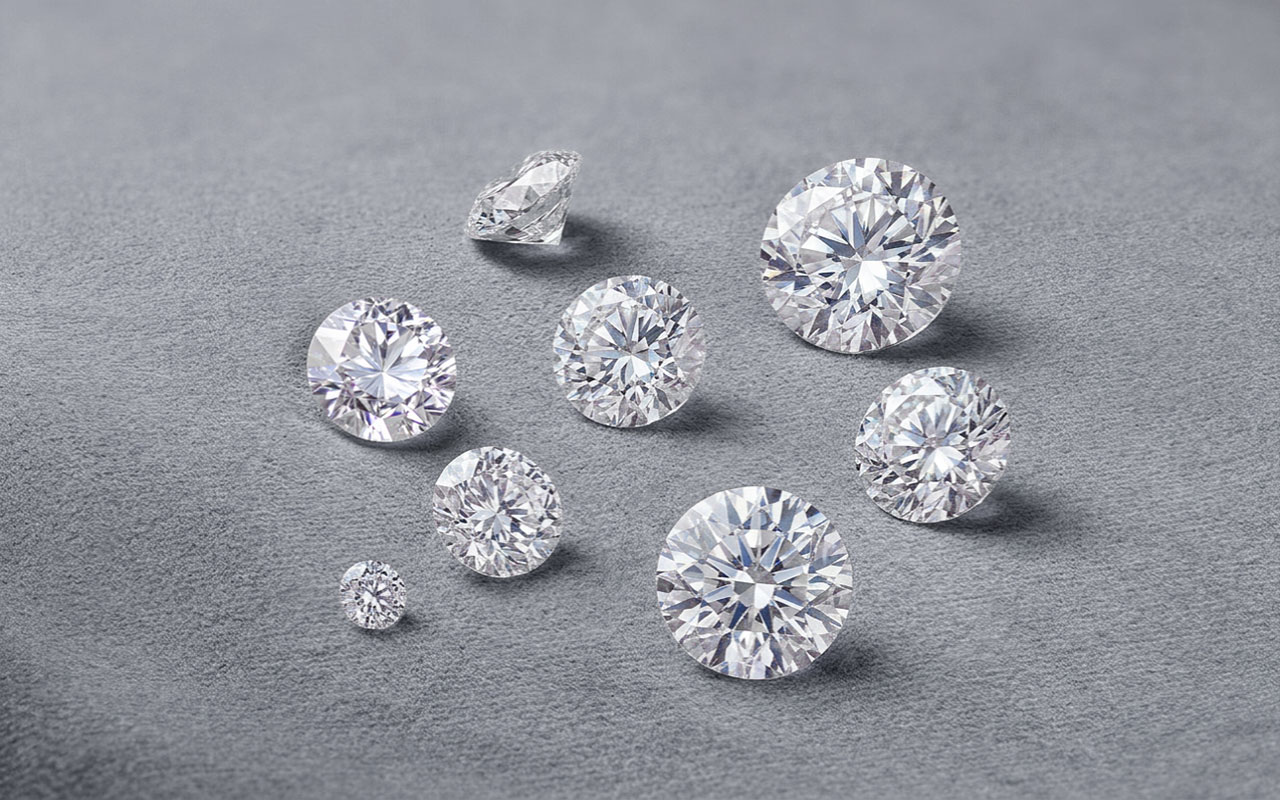
- Generally, color is more important than clarity because it is more noticeable to the naked eye, but this is dependent on a number of factors
- Diamond color measures the absence of yellow or brown tint, graded on a scale from D (colorless) to Z (noticeable color)
- Diamond clarity measures the presence of internal inclusions and surface blemishes, graded from Flawless (FL) to Included (I3)
When shopping for a diamond, two of the four Cs tend to generate the most questions: color and clarity.
Both affect how a diamond looks and what it costs, but they don’t work the same way, and prioritizing one over the other without context can lead to trade-offs that don’t serve you well.
Comparing diamond color vs. clarity means understanding what each grade actually measures, how visible those differences are in real life and which factor deserves more weight given the shape, setting and budget you’re working with.
This guide breaks down both qualities side by side so you can choose the right diamond for you.
Diamond Color vs. Clarity At a Glance
Both color and clarity are part of the universal framework used to evaluate diamond quality called the 4Cs, but they describe two entirely different things:
- Color measures how much (or how little) yellow or brown tint a diamond contains, graded on a D-to-Z scale where D is completely colorless
- Clarity measures the presence of internal inclusions and surface blemishes, graded from Flawless (FL) to Included (I3)
While both factors influence a diamond’s appearance and price, they don’t affect its appearance in the same way or to the same degree. That distinction is what makes smarter shopping possible.
| Color | Clarity | |
| What it measures | The absence of yellow or brown tint, graded D (colorless) to Z (noticeable color) | The presence of internal inclusions and surface blemishes, graded FL to I3 |
| Visibility | Detectable to the naked eye, especially in larger stones or step-cut shapes | Most inclusions are invisible without magnification; eye-visible only in lower grades (SI2 and below) |
| Most impacted by | Diamond shape, setting metal, and carat weight | Diamond shape, carat weight, and inclusion placement |
| Price impact | Significant: colorless grades (D–F) carry a notable premium over near-colorless (G–J) | Significant: FL/IF grades command top prices, while VS2–SI1 offer strong value |
What Is Diamond Color?
Diamond color is graded on a scale developed by the Gemological Institute of America (GIA) that runs from D to Z, measuring the absence of color rather than its presence. A D-grade diamond is completely colorless; as you move down the scale, stones take on increasing traces of yellow or brown.
The differences between adjacent grades (say, G vs. H) are extremely subtle, often invisible to the naked eye outside of a professional grading environment. This means a lower color grade doesn’t necessarily mean a lesser-looking diamond in real life.
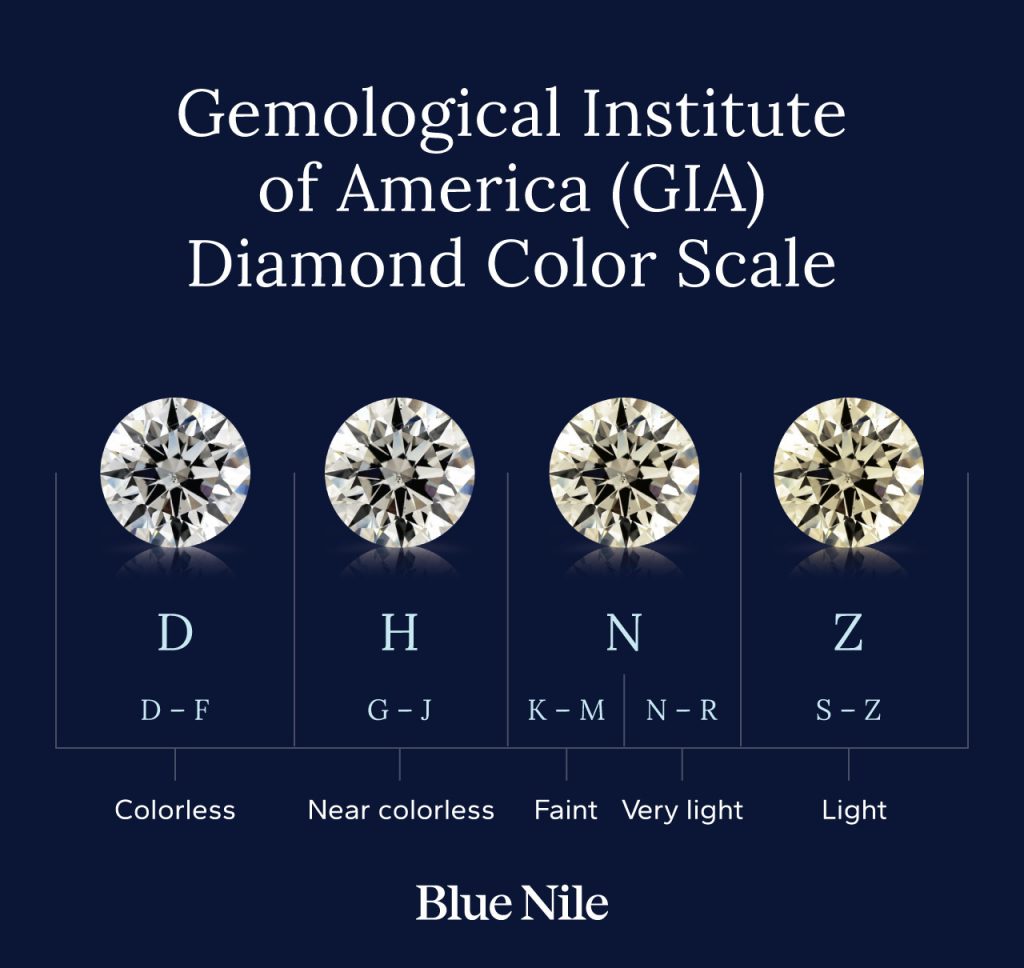
Colorless Diamonds: D, E, and F
D, E and F diamonds sit at the top of the GIA color scale and represent the rarest color grades available. The distinctions between them are imperceptible without professional equipment:
- A D diamond is completely free of any color
- An E diamond contains only trace amounts detectable under magnification by a trained gemologist
- An F diamond has slightly more, though still entirely invisible to the unaided eye
Because of their rarity, colorless diamonds carry a significant price premium. Buyers typically choose them if they prioritize the highest-graded stone on paper or are setting their diamond in platinum or white gold and want to ensure no detectable warmth is visible from any angle.
Near-Colorless Diamonds: G, H, I, and J
G through J diamonds face up white in most settings and lighting conditions, making this the most popular range for engagement rings. At the G and H grades, the faint warmth present is nearly impossible to detect once the diamond is set, even in platinum or white gold.
I and J stones may show a subtle warmth when viewed loose against a white background, but in a yellow gold or rose gold setting, that warmth all but disappears, and many shoppers find these grades look exceptional at a noticeably lower price. For most buyers, G–J is where appearance and value meet.
What is Diamond Clarity?
Diamond clarity measures the presence of inclusions, or the internal characteristics that formed while the diamond was growing, as well as blemishes, which are surface-level imperfections. Every diamond is unique, and most contain some degree of both.
The GIA grades clarity on an 11-point scale, from Flawless (FL) at the top to Included (I3) at the bottom. What matters most to the everyday buyer isn’t where a diamond falls on the full scale, but whether any inclusions are visible to the naked eye. That threshold, known as being “eye-clean,” is where clarity grade starts to have a real impact on appearance.
You can filter by clarity grade on Blue Nile’s diamond search to find stones that meet your standard at your price point.
| Grade | What it means | Eye-clean? | Visibility | Common inclusions |
| FL | No inclusions or blemishes visible under 10x magnification | Yes | Completely clean at any magnification | None |
| IF | No internal inclusions; minor surface blemishes only | Yes | Flawless to the naked eye and under magnification | Minor surface blemishes |
| VVS1 | Inclusions extremely difficult to see under 10x magnification | Yes | Invisible to the naked eye | Pinpoints, needles |
| VVS2 | Inclusions very difficult to see under 10x magnification | Yes | Invisible to the naked eye | Pinpoints, clouds |
| VS1 | Inclusions difficult to see under 10x magnification | Yes | Invisible to the naked eye | Crystals, feathers, needles |
| VS2 | Inclusions somewhat easy to see under 10x magnification | Yes | Invisible to the naked eye in most cases | Crystals, clouds, feathers |
| SI1 | Inclusions noticeable under 10x magnification | Usually | Typically eye-clean; varies by shape and carat | Crystals, feathers, clouds |
| SI2 | Inclusions easily seen under 10x magnification | Sometimes | May be visible to the naked eye depending on stone | Feathers, clouds, crystals |
| I1 | Inclusions obvious under 10x magnification | Rarely | Often visible to the naked eye | Large feathers, clouds |
| I2 | Inclusions very obvious; may affect transparency | No | Visible to the naked eye | Large inclusions, fractures |
| I3 | Inclusions extremely obvious; affects brilliance | No | Clearly visible; impacts durability | Large fractures, heavy clouds |
Color vs. Clarity: Which Is Most Important?
For most, color is more noticeable to the naked eye than clarity, particularly in larger stones. A diamond with a noticeable yellow tint will look that way in everyday lighting, while most clarity inclusions, unless severe, are invisible without magnification.
That said, this isn’t a universal rule. Shape, carat weight, and setting metal all shift the equation, and in some cases, clarity becomes the more pressing consideration. The honest answer is that neither factor is categorically more important than the other. What matters most depends on the specific diamond you’re evaluating and how you plan to wear it.
How to Prioritize Color vs. Clarity Based on Your Budget
Color and clarity both affect price significantly, but they don’t pull in the same direction for every buyer. Moving up one color grade typically costs more than moving up one clarity grade at the same carat weight, which means budget-conscious shoppers often find more value in dialing back on clarity than on color.
The key is knowing where each grade starts to make a visible difference, and where it doesn’t.
| Budget priority | Suggested color | Suggested clarity | Why it works |
| Maximize appearance | D–F | VS1–VS2 | Colorless grades paired with eye-clean clarity deliver the most polished look; best for step cuts or solitaire settings where both factors are most visible |
| Balance both | G–H | VS2–SI1 | Near-colorless diamonds in this range face up white in most settings and are typically eye-clean, offering strong appearance at a more accessible price |
| Prioritize size | I–J | SI1–SI2 | Warmer color grades paired with eye-clean SI stones allow budget to go toward carat weight; works especially well in yellow or rose gold settings |
How Diamond Shape and Setting Change the Equation
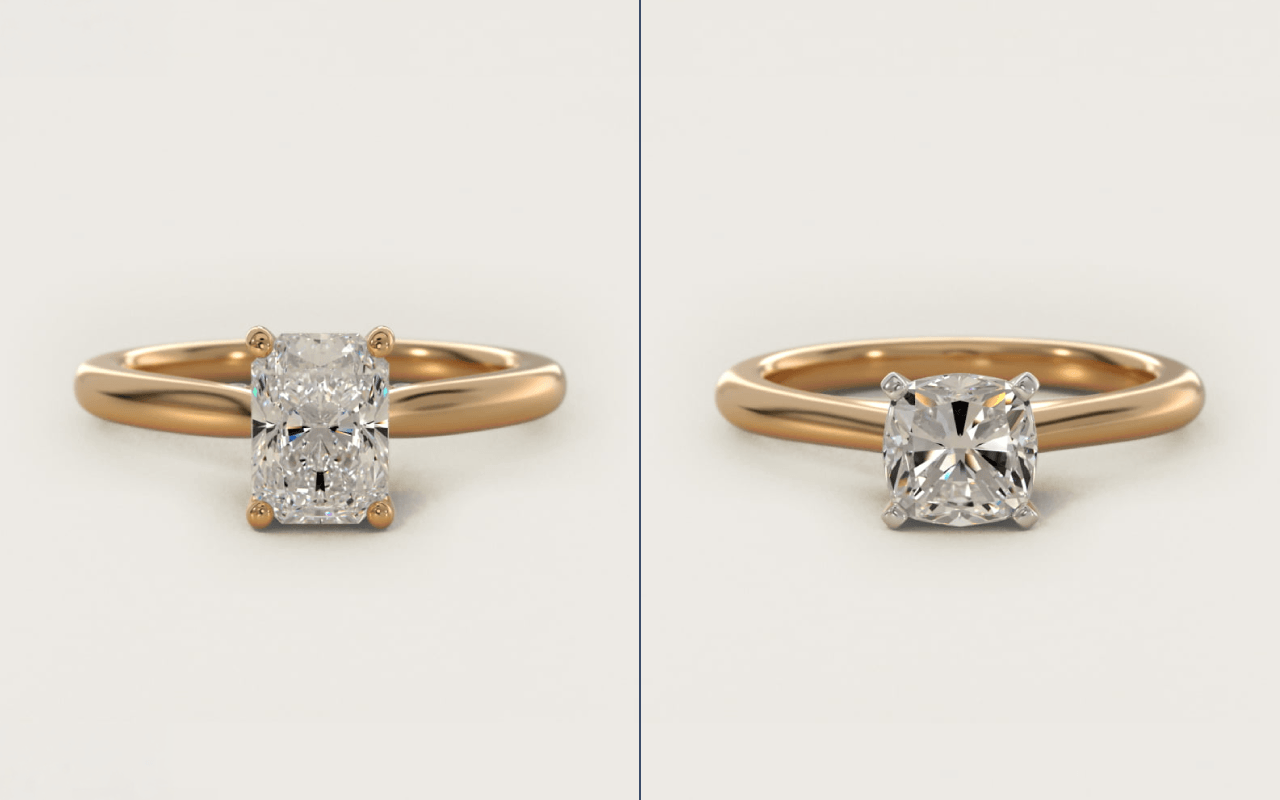
Shape and setting metal don’t change your diamond’s grades, but they significantly change how those grades appear in real life. A diamond’s cut style determines how light moves through the stone, which directly affects how much color or how many inclusions the eye can detect.
Setting metal works similarly: the color it reflects into the diamond can either mask warmth or amplify it. Understanding both factors before you shop helps you make smarter trade-offs at every price point.
Impact of diamond shape on color:
- Brilliant cuts (round, oval, cushion, pear, marquise) scatter light through dozens of facets, effectively masking color. Buyers can often go one to two grades lower without any visible difference.
- Step cuts (emerald, Asscher) feature long, open facets that act more like windows than mirrors, making color easier to detect. These shapes generally call for H or above.
- Fancy shapes with pointed tips (oval, pear, marquise) can concentrate color at the ends, a phenomenon known as “bowtie” or tip color—worth viewing in person or via 360° imagery before buying.
Impact of diamond shape on clarity:
- Brilliant cuts disperse light in ways that naturally camouflage inclusions, making SI1 and even some SI2 stones appear eye-clean more consistently.
- Step cuts show inclusions more readily due to their open, hall-of-mirrors facet structure. VS2 or better is generally recommended for emerald and Asscher cuts.
- Larger carat weights amplify both color and clarity concerns regardless of shape. What’s invisible in a 0.80 ct. stone may be detectable in a 2.00 ct. stone of the same grade.
| Shape | Color | Clarity |
| Asscher | G or above | VS2 or above |
| Cushion | H or above | SI1 or above |
| Emerald | G or above | VS2 or above |
| Heart | H or above | VS2 or above |
| Marquise | H or above | SI1 or above |
| Oval | H or above | SI1 or above |
| Pear | H or above | SI1 or above |
| Princess | H or above | SI1 or above |
| Radiant | H or above | SI1 or above |
| Round Brilliant | I or above | SI1 or above |
Finding the Right Balance with Blue Nile
Diamond color vs. clarity is less about choosing one over the other and more about knowing how each factor behaves in the specific diamond you’re considering. Shape, setting and carat weight all influence how much either quality shows up in real life, and in most cases, the right balance looks different for every buyer.
Find the right diamond for you with Blue Nile.
Frequently Asked Questions
For most buyers, color is the more noticeable factor. A diamond with visible warmth will show it in everyday light, while most clarity inclusions are invisible without magnification. However, the right priority depends on the shape and setting you’re working with, so it’s worth evaluating both in the context of your specific stone.
VS2 and SI1 clarity grade diamonds tend to offer the best price-to-appearance ratio. Both grades are typically eye-clean in most shapes and lighting conditions, and they offer meaningful savings over FL, IF, and VVS grades without any visible trade-off in everyday wear.
Yes, the setting metal can affect diamond color. Platinum and white gold reflect cool, neutral light, making any warmth in a diamond more apparent, while yellow and rose gold cast a warm tone that neutralizes lower color grades.
Both VS1 and VS2 diamond grades are eye-clean and virtually indistinguishable in normal viewing conditions. A VS1 vs. VS2 comparison often comes down to price. VS2 typically offers the same appearance at a lower cost, making it the stronger value choice for most buyers
The best way to tell if an SI1 or SI2 diamond is eye-clean is to review HD or 360° imagery of the specific stone before purchasing. Because they vary widely within the same grade, two stones with identical clarity labels can look quite different; placement and type of inclusion matter as much as the grade itself.


Share