Key Takeaways:
- Elongated cushion cuts are square with rounded corners, while oval cuts are completely rounded ellipses.
- Ovals appear more slender and have larger face-up sizes, while elongated cushions are more compact but offer a unique shape.
- Ovals are more prone to the bow-tie effect, while elongated cushions hide inclusions well.
- Ovals are more popular, and thus more expensive, than elongated cushions.
Elongated cushions are squarish, while ovals are rounder, right? While that’s a start, it’s not quite the whole story.
Weighing the elongated cushion cut vs. the oval cut is a common dilemma for engagement ring shoppers. Both shapes offer a lengthened look and elegant appeal, yet they differ significantly in light behavior and on-hand appearance.
In this guide, we’ll cover the differences in sparkle, visual presence, color, clarity and pricing between these two diamond shapes. Read on to put the debate to rest and commit to the right shape for you.
What’s the Difference Between Elongated Cushion Vs. Oval Cut Diamonds?
Elongated cushion cut diamonds are modern takes on the vintage old mine cut, with square shapes and rounded corners.
In contrast, oval-cut diamonds are elongated round cuts with a continuous curve around the outline. Since the 1700s, they’ve seen peaks of popularity throughout history, giving them a timeless feel.
That’s the most obvious difference, but the contrasts don’t stop there. Below, we’ll cover more distinctions between the two.
| Elongated Cushion | Oval | |
| Shape | Rectangle with rounded corners | Ellipse with continuous curve |
| Popular length-to-width ratio | 1.10 to 1.30 | 1.30 to 1.50 |
| Finger coverage | Elongated but more compact | Elongated and slender |
| Sparkle style | Subtle | Lively |
| Bow-tie risk | Low to medium | Medium to high |
| Light performance | Soft sparkle | Fiery brilliance |
| Face-up size | Appears slightly smaller | Appears larger |
| Setting compatibility | Halo | Solitaire |
| Color visibility | Color concentrates in corners | Uniform color throughout |
| Clarity | Hides inclusions well | Inclusions may be more noticeable |
| Price range | Lower | Higher |
| Popularity | More niche | High demand |
Shape and Silhouette: Comparing the Outlines
An oval’s outline is a smooth, continuous ellipse, while the elongated cushion’s outline is a pillow-like rectangle with softly rounded corners. Visually, the elongated cushion’s silhouette is somewhere between a classic square cushion and an oval.
The cushion’s straight edges provide a more geometric, structured silhouette compared to the oval’s fluid, organic curve. This slight difference in shape makes the oval read as more traditionally slender, while the elongated cushion has a more unique shape.
Understanding Length-to-Width Ratios
Ovals and elongated cushions have differing length-to-width ratios, which play a big role in their aesthetics. In general, ovals tend to have a higher length-to-width ratio, with a more stretched appearance. Elongated cushion ratios tend to be lower, which makes them appear more compact and balanced.
Most popular ratios for each:
- Oval: Popular versions typically have a length-to-width ratio of 1.30-1.50. Many people consider 1.35 to 1.45 the oval “sweet spot.” An extra elongated oval diamond may have an even higher elongation ratio, appearing even slimmer.
- Elongated cushion: Typically ranging from 1.15 to 1.20, some elongated cushions reach a ratio of 1.30. A ratio of 1.10 looks nearly square, while anything above 1.25 pushes the cushion closer to an oval silhouette.
However, note that while these ratios provide a baseline, it’s best not to get too caught up in the numbers. The final choice should be based completely on your visual preference when the ring is on your finger.
Finger Flattery: How Each Shape Wears
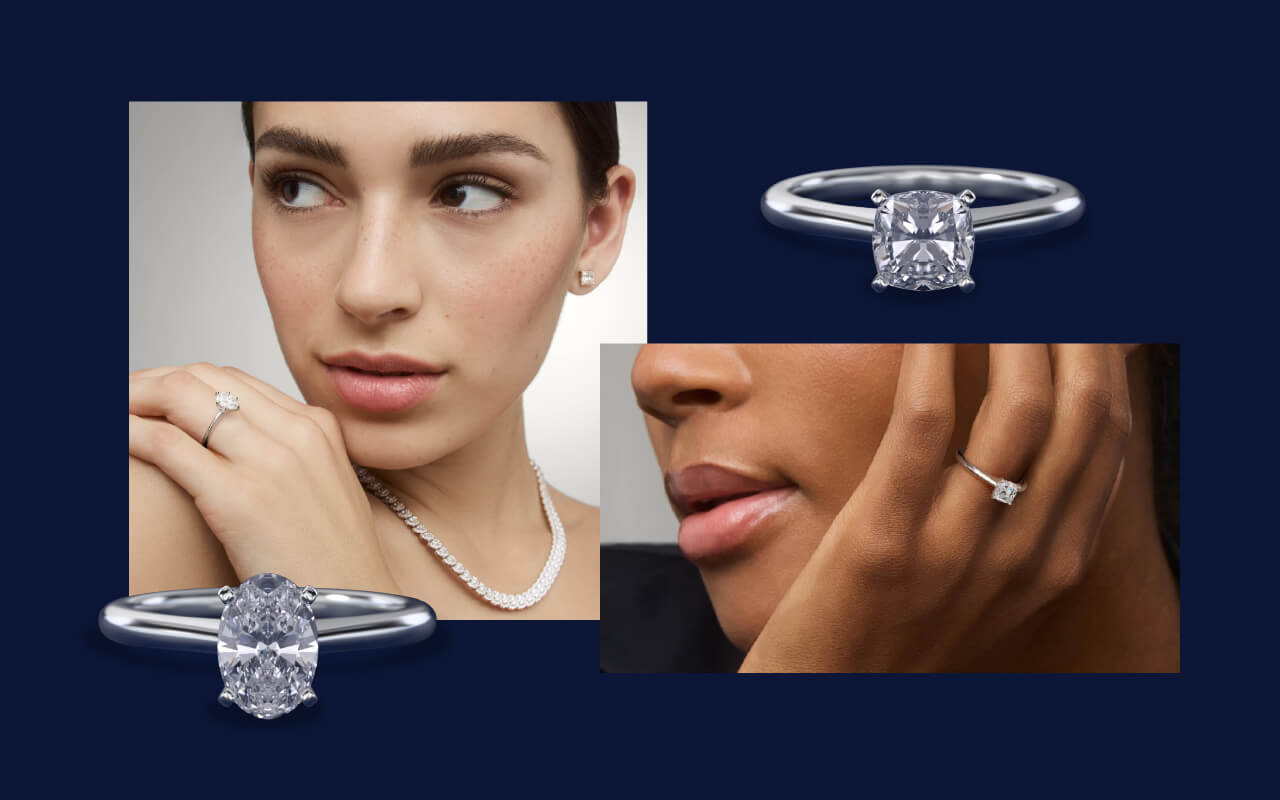
The oval’s continuous curve visually lengthens shorter or wider fingers more effectively than the cushion’s structured edges. In contrast, the elongated cushion’s straight sides can emphasize finger width on very short fingers, but look highly proportionate on medium to long ones.
Key hand factors that come into play with each shape are finger length, width, hand size and knuckle prominence. Again, there are no strict rules, and you should base your purchase entirely on your preference when the ring is on your hand.
However, here’s a quick guide to which diamond shapes generally flatter which types of fingers:
- Short/wide fingers: Benefit from the slendering and elongation effect of ovals
- Medium/long fingers: Suited to either
- Larger hands/long fingers: Well-filled by the bold presence of an elongated cushion
Sparkle and Light Performance: How They Differ in Real Life
While both ovals and elongated cushions are modified brilliant cuts, their facet structures produce distinct visual personalities. In general, here’s the sparkle behavior of each:
- Oval: Uses a modified round brilliant pattern to produce bright, white flashes and high contrast
- Elongated cushion: Varies by cut style, producing either large, “chunky” flashes or a “crushed-ice” glittery effect that is generally warmer and softer than an oval
Ovals tend to perform more consistently across different lighting environments, while elongated cushions can provide more visual depth.
However, the Gemological Institute of America (GIA) does not provide cut grades for these shapes. You’ll need to rely on in-person try-ons, vendor videos or 360-degree imaging to evaluate the sparkle for yourself.
The Bow-Tie Effect: Severity and Evaluation
The bow-tie effect is a dark shadow across the center of a diamond caused by light leakage. When faint, it can add depth, but a severe, dark bow-tie is distracting and indicates a low-quality cut. That’s why cut quality matters immensely, even more so than shape.
Know that while both shapes can exhibit the bow-tie effect, ovals are more consistently prone to it due to their elliptical facet geometry.
If you’re looking for the bow-tie effect online, watch video footage of the diamond in motion to see if the center shadow disappears or remains static.
Crushed-Ice vs. Chunky Cushion: Why the Cutting Style Matters
If you’re honed in on elongated cushions, you’ll need to choose between cutting styles. Here are the two types:
- Chunky (large, defined facets): Offers high-contrast sparkle similar to a round brilliant cut
- Crushed-ice (small, fragmented facets): Offers a finer, diffused glitter. Crushed-ice cushions often mask the bow-tie effect better than ovals or chunky-cut cushions.
Note that GIA certificates do not distinguish between these styles. You’ll need to identify them visually in person or via video.
Face-Up Size and Visual Presence
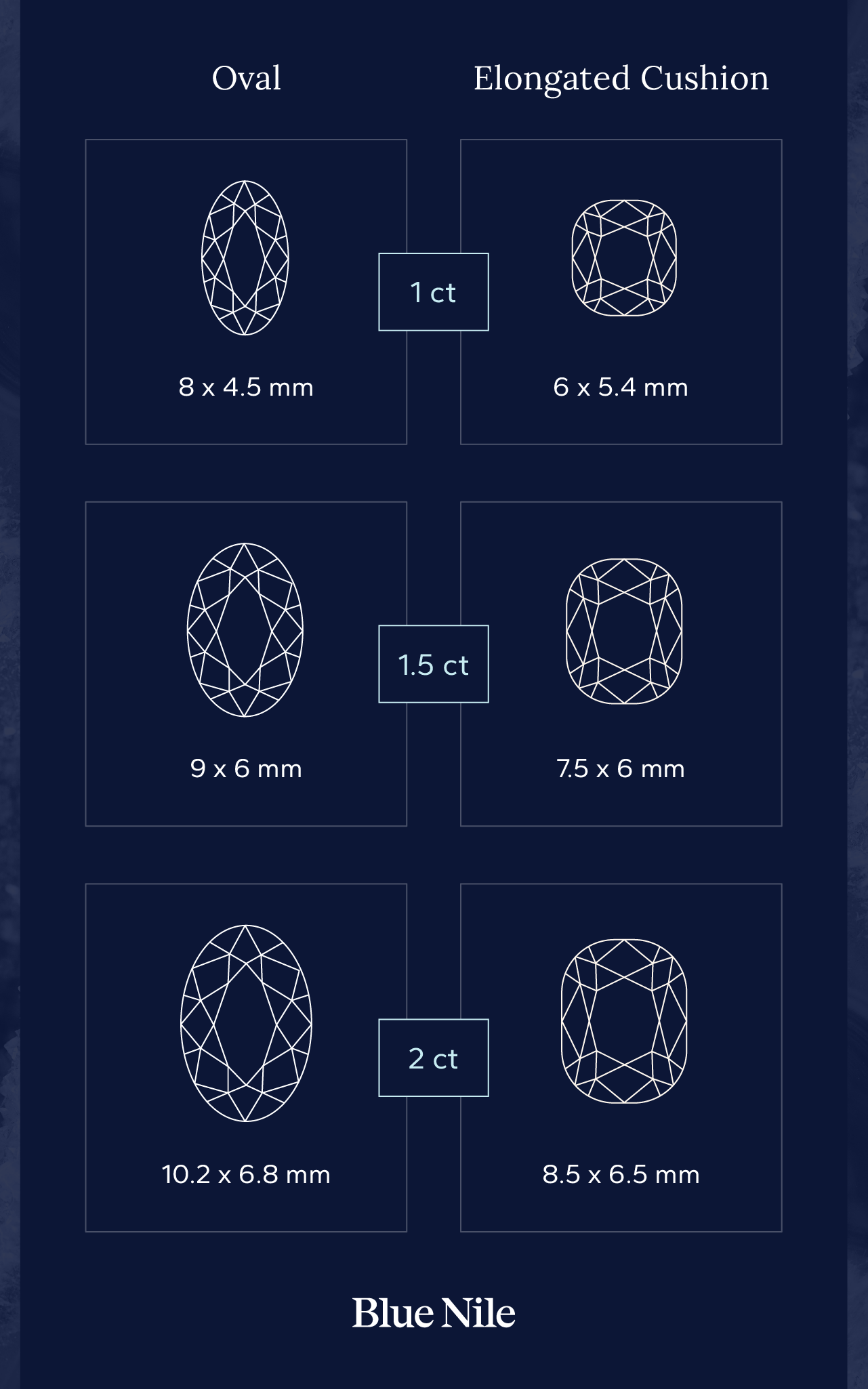
Comparing ovals’ vs elongated cushions’ visual presence, ovals have the greater face-up size. Face-up size is the visual surface area when viewed from above, distinct from how different carat weights look on a finger.
Here’s an elongated cushion cut size comparison with ovals:
- Oval: A 1.50ct oval is roughly 9.0 x 6.0mm. An oval’s shallow depth spreads its weight evenly across the surface.
- Elongated cushion: A 1.50ct elongated cushion is roughly 7.5 x 6.0mm. The face-up area is lower than an oval’s due to its greater depth. This depth also means it sits higher in a ring setting.
Due to their larger face-up size, some argue that ovals are a great choice for buyers who prioritize maximum visual size for their spend.
Setting Compatibility and Style
Setting and style also play a role in the choice between ovals and elongated cushion rings.
Halo settings amplify the size of both shapes, but provide a more significant proportional boost to the cushion, making it appear larger. The growing “east-west” setting trend is also ideal for elongated cushions, emphasizing the rectangular look. On the other hand, solitaire settings highlight the oval’s natural elongation and let its sleep shape stand out.
When it comes to metal color, yellow or rose gold pairs beautifully with the softer cushion sparkle. White gold or platinum highlights an oval’s high-contrast flashes.
Color and Clarity: Which Shape Shows More?
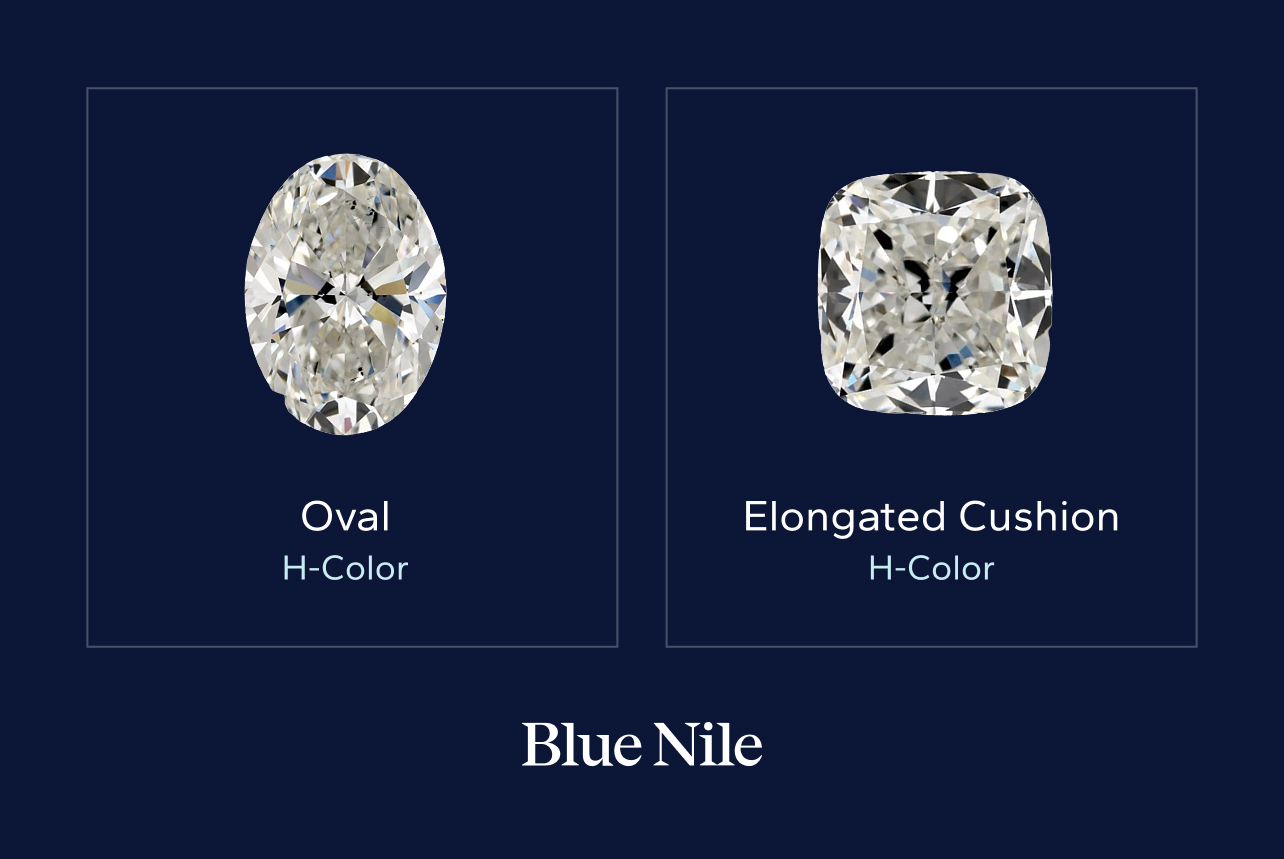
Both oval and elongated cushions are fancy-shaped diamonds, which retain color better than round diamonds. Elongated cushions tend to concentrate color in their corners, while ovals often distribute color more evenly across their surfaces.
Here are color buying considerations for color and clarity:
- Ovals: G-H (natural) and G or better (lab-grown) provide a near-colorless look.
- Elongated cushion: H or better (natural) and F or better (lab) minimize the color concentration in corners.
When it comes to clarity, both shapes are forgiving. Crushed-ice cushions are particularly effective at masking inclusions (imperfections within the stone). That makes them ideal if you’re working with a clarity grade of VS2 or SI1.
However, note that what matters most isn’t the GIA clarity grade but the “eye-clean” standard. If the inclusions are invisible to the unaided eye, they meet most quality standards for buyers.
Pricing and Popularity
Ovals typically carry a price premium over elongated cushions of equivalent quality due to higher market demand. The elongated cushion is generally more affordable, allowing you to get a larger or higher-quality stone for the same budget. It’s priced lower only because of higher rough retention during cutting and lower relative demand.
This price gap narrows a bit for lab-grown diamonds, though the oval remains the overall more expensive shape.
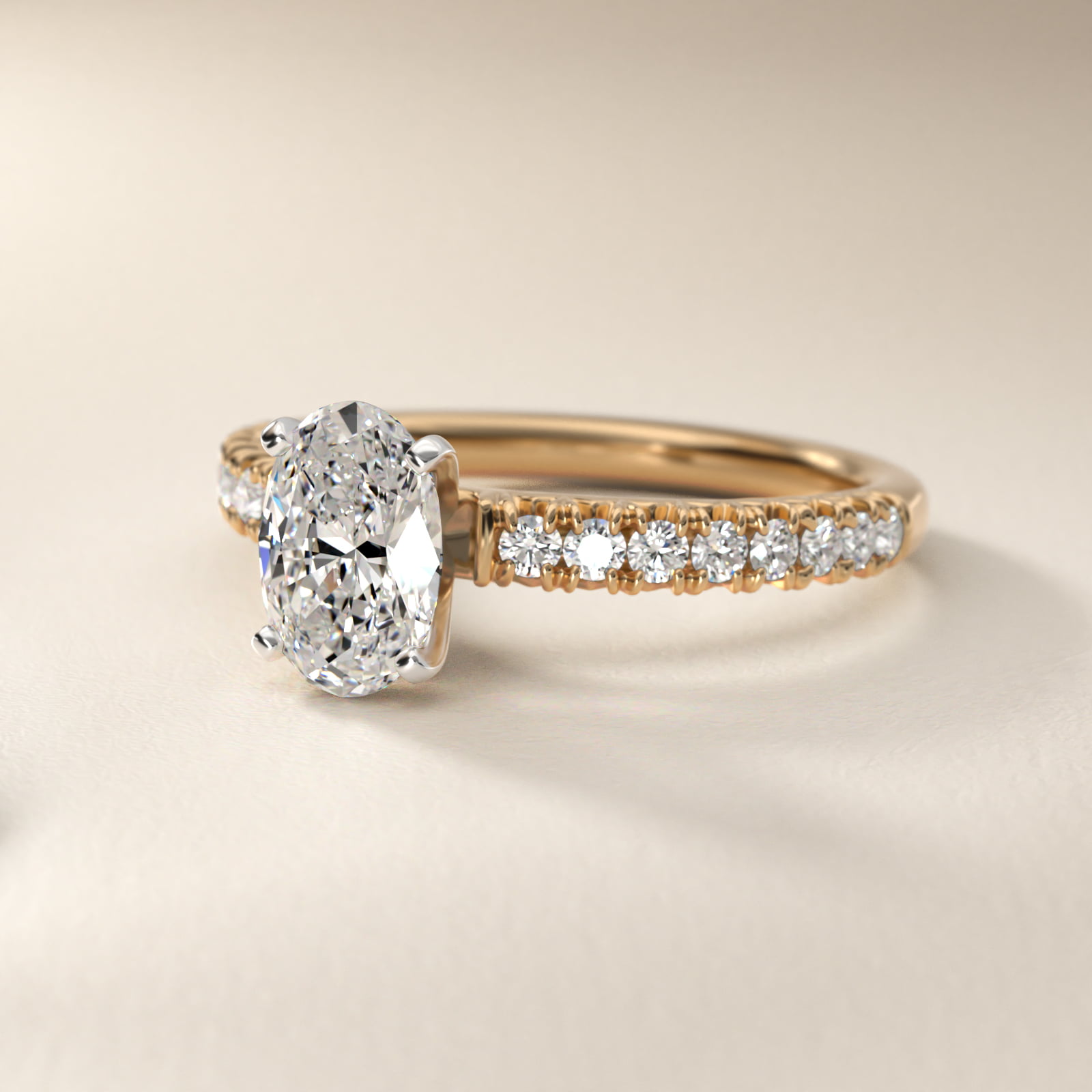
Oval Cut 1.5 CT Certified Lab-Grown Diamond French Pavé Engagement Ring In 14K Yellow Gold
Shop Oval Rings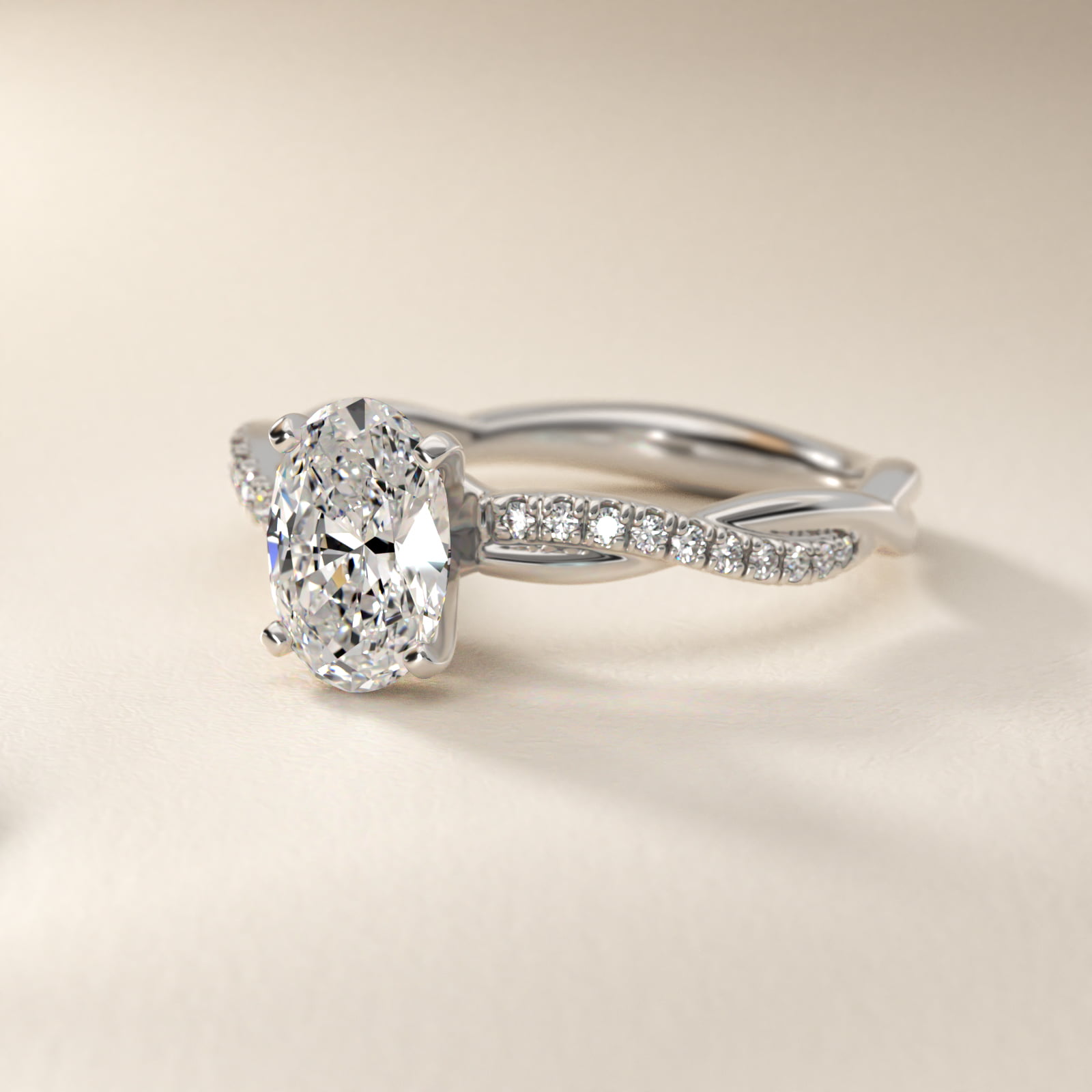
Oval Cut 2.5 CT Certified Lab-Grown Diamond Petite Twist Engagement Ring In Platinum
Shop Oval RingsHow to Choose the Right Shape for You
View both shapes in person or in video, as still photos on white backgrounds may mislead you about how the diamond will look in everyday settings. If you’re watching vendor videos, request side-by-side comparison videos to see both shapes under identical lighting.
Here are a few scenarios to help finalize your choice:
| If You Want … | You Might Prefer… |
| Maximum face-up size | Oval |
| Vintage-inspired, bold silhouette | Elongated cushion |
| Classic, timeless look | Oval |
| Softer, romantic feel | Elongated cushion |
If you’re leaning toward the elongated cushion, consider a few other cuts that are similar to it:
- Radiant cut, if you like the crushed ice faceting but want clipped straight corners instead of rounded ones
- Cushion cut, if you like the pillow look but not the rectangular shape
- Emerald cut, if you like the rectangular shape but you want step-cut facets that create a “hall of mirrors” effect
Questions to Ask Your Jeweler
Use this checklist of final questions with your jeweler to ensure cut quality and that the diamonds you’re looking at align with your preferences:
- Can I see a video in natural lighting? Natural light reveals a diamond’s true brilliance and color, which can look very different under artificial light.
- What is the exact length-to-width ratio? This ratio affects the diamond’s elongation and is key to achieving the look you want.
- Is this a chunky or crushed-ice cut? These are important for distinguishing the types of sparkle in an elongated cushion cut.
- Is the bow-tie prominent in motion? A prominent and shadowy bow-tie effect can be distracted when the ring catches the light on your finger.
- What is the depth percentage? Too much depth can make the diamond look small, and too little can cause light leakage. Ideal depths ensure maximum brilliance.
Find Your Cut with Expert Help
The right choice between an elongated cushion and oval diamond cuts depends on your preferred aesthetic. Elongated cushions provide soft, vintage-inspired sparkle, while ovals offer classically brilliant shine.
Ready to browse? Explore our selection of oval and elongated cushion cuts to see how these diamonds differ by carat weight and color. At Blue Nile, our experts are here to help you find the perfect stone to match your style.
Frequently Asked Questions
Ovals tend to look bigger than elongated cushions. That’s because ovals usually have larger face-up sizes, or visual surface area when viewed from above.
An elongated cushion diamond can have a bow-tie effect. Some are more pronounced than others. However, they are less likely to have this effect than oval diamonds.
Oval diamonds are generally considered better for short fingers, since their elongated shape creates the illusion of length. The elongated cushion, while still elongated, tends to look slightly more compact.
Elongated cushions are more affordable than ovals. That’s because ovals are more popular and in higher demand, while elongated cushions are more unique and niche.
The best length-to-width ratio for elongated cushion cuts is 1.15-1.30. Ratios above 1.25 push the diamond closer to an oval shape. Anything below 1.15 will appear squarish.
Due to its corners and larger facets, elongated cushions show more color, especially concentrated in their corners. An oval’s color will appear more uniform across the entire stone.
Elongated cushions are similar to radiant cuts, though where radiant cuts have sharply cut off corners, elongated cushions’ corners are soft and curved.


Share