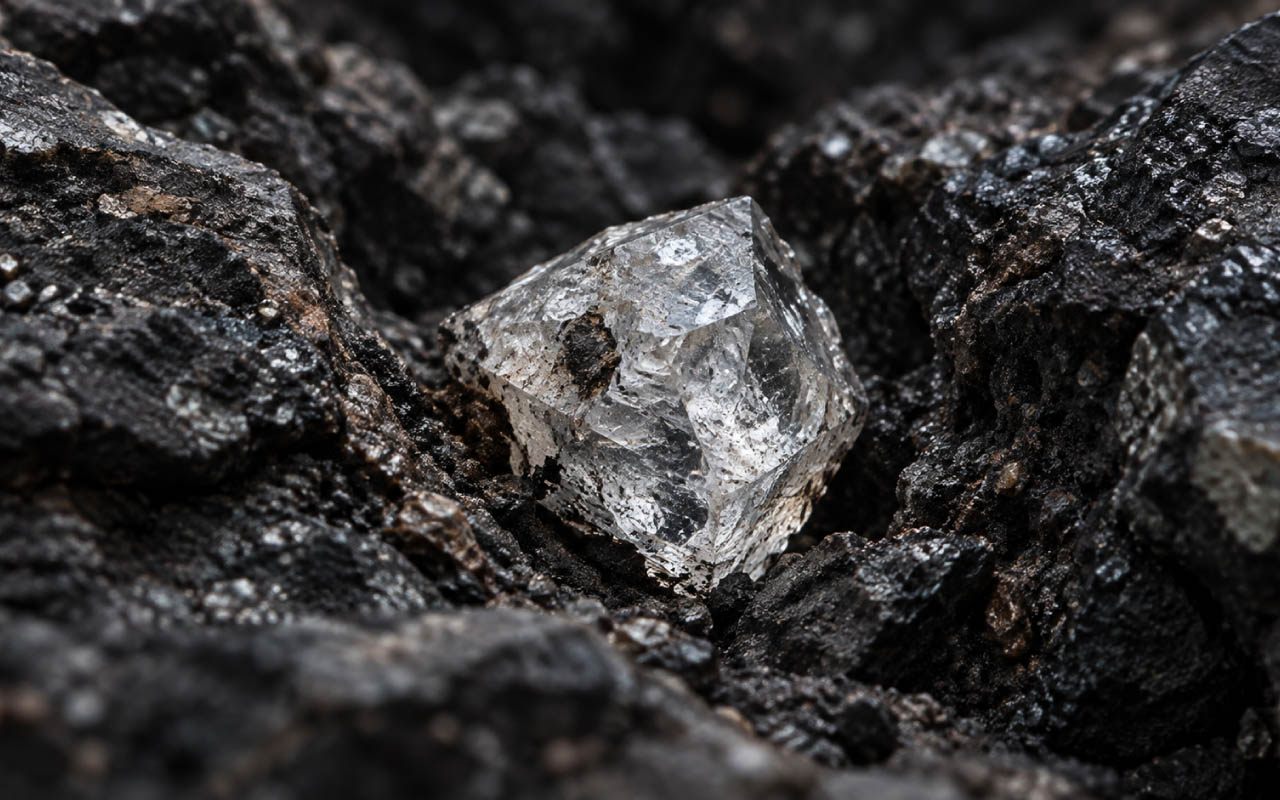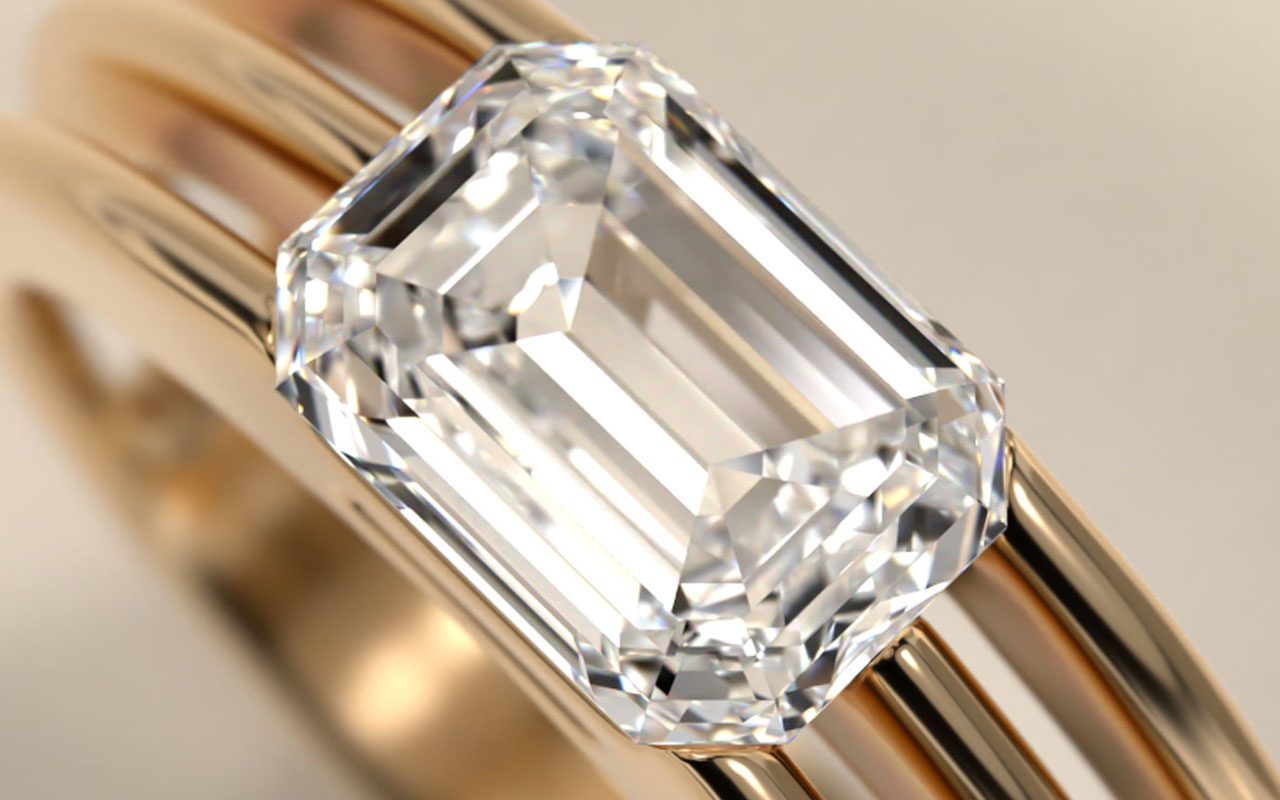
- Diamond inclusions are natural, internal features that form as the gemstone develops.
- Most diamond inclusions are not visible to the unaided eye.
- Blue Nile’s diamond experts can help you confidently choose the right diamond clarity for your needs.
Ready to pop the question? Choosing a diamond is an exciting step, and understanding the details behind its brilliance makes the process even more rewarding.
Diamond inclusions are among the most important details to consider. These tiny internal characteristics form naturally during the diamond’s creation and are as unique as a fingerprint.
In this guide, you’ll learn what diamond inclusions are, the most common types to watch for and how to shop confidently for a diamond that fits both your standards and your budget.
What Are Diamond Inclusions?
Diamond inclusions are internal features—such as minerals, fractures or growth marks—that form while the diamond develops underground or in a lab. Almost all diamonds contain inclusions; even VS1 and VS2 diamonds have them.
While some inclusions can affect clarity or durability, many are invisible to the unaided eye and have little to no impact on a diamond’s overall beauty.
Inclusions are different from blemishes, which appear on the surface of a diamond. Both factor into a diamond’s clarity grade, one of the Four Cs of diamond quality.
15 Common Types of Diamond Inclusions
Inclusions are part of a diamond’s characteristics. Some inclusions are harmless and visible only under magnification, while others can affect durability. Here’s what to know about the most common types:
| Type | What it looks like | Visibility risk | Durability risk |
| 1. Bearding | Hair-like lines near the girdle | Medium | Medium |
| 2. Bruise | Tiny impact mark | Medium | Medium |
| 3. Cavity | Small hole or opening | Medium | Medium–High |
| 4. Chip | Small break on the surface | Medium | High |
| 5. Cloud | Group of pinpoints creating haze | Depends on the size of the cloud | Low |
| 6. Crystal | Embedded mineral within the diamond | Medium–High | Low |
| 7. Etch channel | Hollow, tunnel-like feature | Low | Low |
| 8. Feather | Small internal crack | Medium-High | High if surface-reaching |
| 9. Graining | Hazy or reflective internal lines | High if lines are severe | Low |
| 10. Indented natural | Unpolished natural surface | Low | Low |
| 11. Knot | Crystal reaching the surface | Medium | Medium |
| 12. Laser drilling | Fine lines from the treatment process | Medium-High | Low |
| 13. Needle | Long, thin internal line | Low | Low |
| 14. Pinpoint | Tiny white or black dots | Low | None |
| 15. Twinning wisp | Twisted inclusions formed during growth | Medium | Low |
1. Bearding
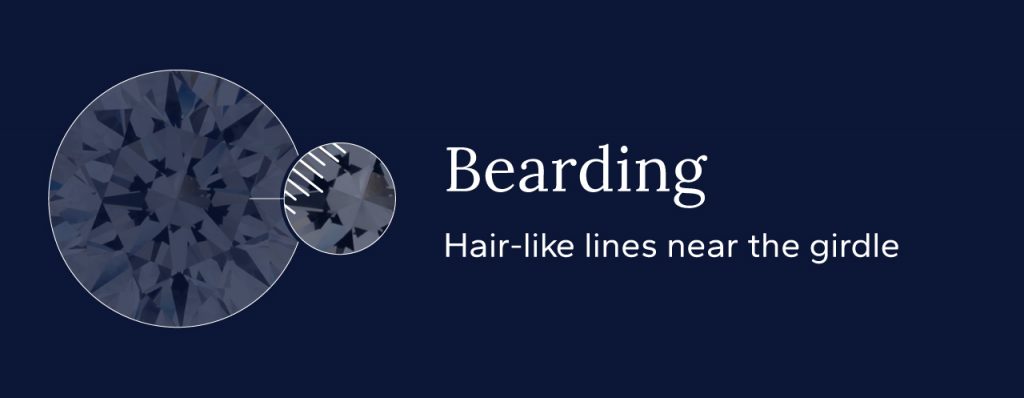
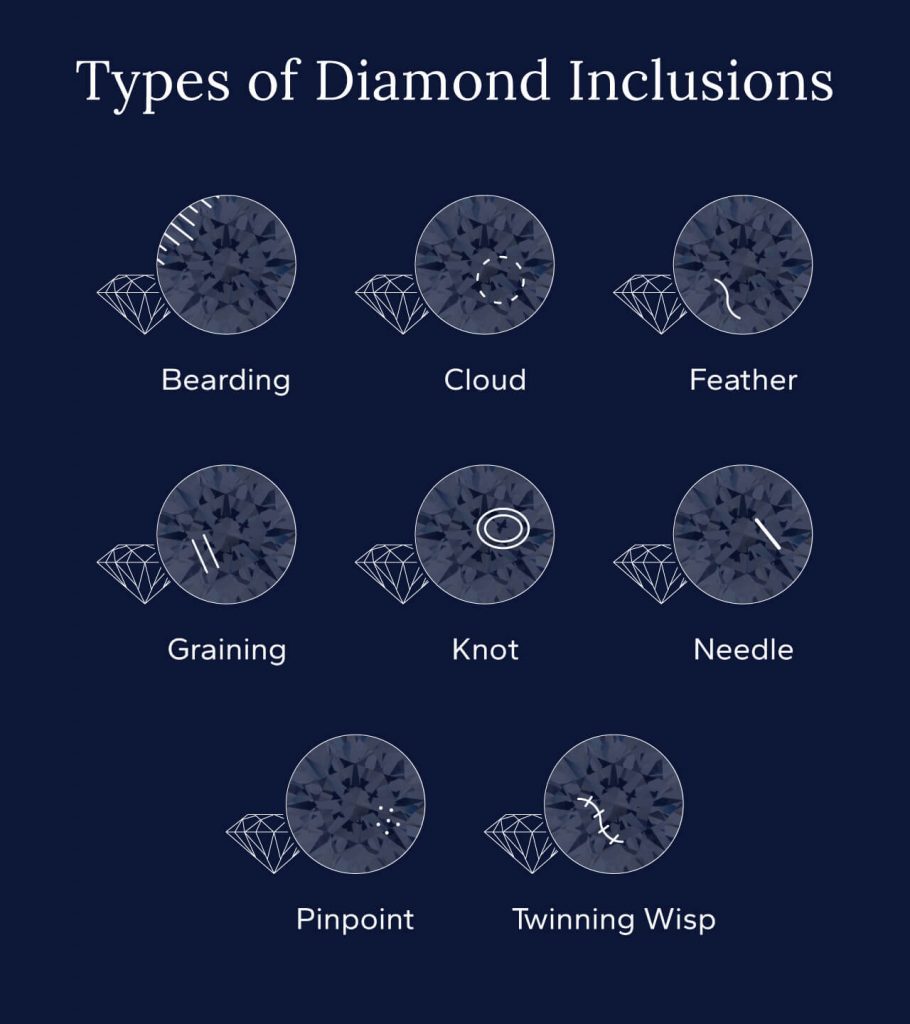
Bearding refers to fine, hairline fractures that extend from the girdle (the outer edge) into the diamond. These types of diamond inclusions typically form during the cutting process, especially when too much speed or pressure is applied to the girdle. Under magnification, bearding looks like soft, wispy lines around the edge of the stone.
Excessive bearding can create a slightly fuzzy appearance along the girdle. However, in most professionally cut diamonds, bearding is minimal and not visible to the naked eye.
2. Bruise
Bruises occur when a diamond experiences a sharp impact, causing a small, shallow fracture often surrounded by tiny feathers or crystals. Under magnification, a bruise may resemble a starburst or spiderweb.
This type of inclusion poses a significant risk in high-contact areas. While minor bruises can be harmless, larger ones or those near the edges may reduce the diamond’s overall durability.
3. Cavity
A cavity is a small opening or hole on the diamond’s surface, often created when a crystal becomes dislodged during diamond polishing. It may look like a tiny pit or divot and is typically visible under 10x magnification.
Cavities can collect dirt or oil, making them more noticeable over time. If located on the crown or near an edge, they may also pose durability risks. That said, small cavities situated away from high-contact areas are rarely a deal breaker.
4. Chip
A chip is a slight break on the surface, usually caused by wear or accidental impact. It often looks like a tiny missing piece near the diamond’s edge or point.
Chips may grow over time if the diamond is exposed to pressure. When shopping for everyday jewelry, avoid chips near high-risk areas like the girdle or corners.
5. Cloud

A cloud is a group of tightly clustered pinpoint inclusions that can create a hazy or milky area within the diamond. Depending on the number and density of these inclusions, a cloud may appear soft and diffuse or remain completely invisible.
Small or off-center clouds pose no threat, but large ones can diminish brilliance, particularly if they appear beneath the table (the large, flat top facet) or in several spots. This is a scenario where expert inspection is essential.
6. Crystal
A crystal is another mineral that forms inside the diamond. Crystals can vary in color—white, black, red, green—and in visibility, depending on their size and placement. They often appear as tiny dots, but larger crystals may be visible without magnification.
Crystals are one of the most common types of inclusions, and they can occasionally hide beneath facets or prongs. When located under the table, dark crystals may lower clarity more than light-colored or well-positioned ones.
7. Etch channel
Etch channels are hollow, tunnel-like inclusions that form when a diamond encounters corrosive fluids or gases after its growth. They resemble thin, elongated lines or grooves under magnification.
Because they are internal and typically small, etch channels rarely affect a diamond’s appearance or strength. They’re commonly found in step-cut diamonds and frequently noted on grading reports. Shoppers seldom worry about them.
8. Feather
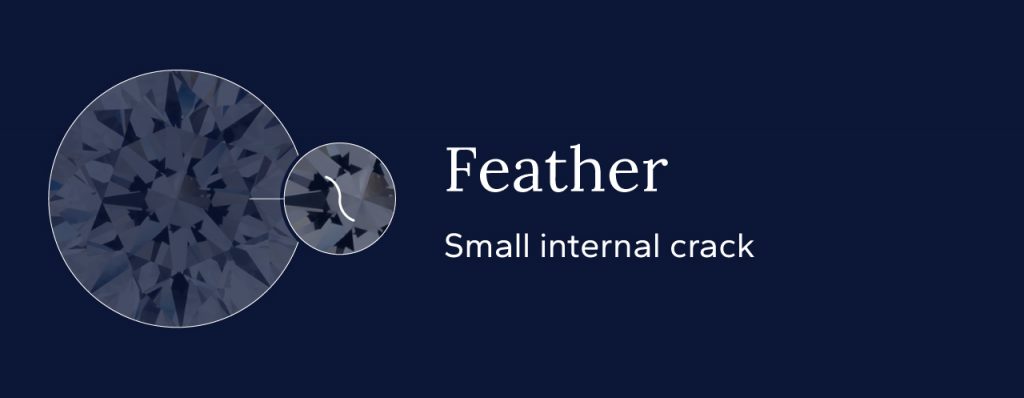
Feathers are small internal fractures that can resemble white, wispy cracks. Their appearance varies: some are nearly invisible, while others display a silvery shimmer.
Feathers become a concern when they reach the surface or sit near edges or corners. In these areas, they may weaken the structure, especially in pointed shapes like princess or pear cuts.
9. Graining

Graining results from irregular crystal growth within the diamond. It may appear as faint lines, angles or hazy areas under magnification. Depending on the light and the diamond’s cut, it can also create a reflective or milky appearance.
In most cases, graining is minor and doesn’t affect the diamond’s beauty. However, when graining is more prominent or located in more visible areas, it can reduce visual clarity and brilliance.
10. Indented natural
An indented natural is an unpolished area of the original diamond’s surface that dips below the polished plane. Cutters intentionally leave it to preserve carat weight.
Indented naturals are normally near the girdle and seldom affect appearance or durability. They are often concealed once the stone is set.
11. Knot

Knots are crystals that reach the diamond’s surface and appear as raised or uneven spots under magnification. They can disrupt the polish and occasionally affect symmetry or light performance.
While not always visible to the unaided eye, knots are important to note when evaluating clarity. A large or poorly placed knot may interfere with a clean finish or even pose durability risks during setting.
12. Laser drilling
Laser drilling is a man-made inclusion created intentionally to remove dark crystals. The process involves using a laser to reach and bleach or dissolve the inclusion, leaving behind small internal tunnels known as laser drill holes or laser channels.
Though these laser trails are visible under magnification, they generally don’t affect the diamond’s sparkle or structure. The industry accepts laser drilling, but sellers must disclose it. Blue Nile doesn’t use laser drilling for its diamonds.
13. Needle

Needles are long, thin crystal inclusions that resemble tiny rods or slivers under magnification. They are usually white or transparent and go unnoticed unless densely packed.
A single needle rarely impacts a diamond’s beauty or durability. However, multiple needles clustered together can form a faint haze, especially in larger stones or lighter shapes like emerald cuts.
14. Pinpoint

Pinpoints are among the tiniest inclusions—small specks that may appear white, black, or transparent. Individually, they’re virtually impossible to see without magnification and pose no durability risk. However, when several pinpoints are grouped together, they may cause a cloud-like effect.
Most diamonds contain pinpoints, and they’re often positioned away from high-visibility areas, making them a non-issue in most cases.
15. Twinning wisp

Twinning wisps are twisted, ribbon-like inclusions formed during a diamond’s crystal growth. They consist of multiple inclusion types—such as pinpoints, clouds and graining—all swirled together.
These inclusions are more common in fancy-shaped diamond cuts, like marquise or pear cuts. Depending on their location and density, twinning wisps can be purely cosmetic or slightly affect light reflection. Placement matters most here.
Diamond Inclusions to Avoid
Most inclusions have no bearing on beauty or durability, but depending on the severity of the inclusions, some are best avoided for long-term value. Here’s are things to keep in mind:
| What to look for | Why it’s important | |
| Size | Larger inclusions | More visible, may affect clarity |
| Color/contrast | Dark or high-contrast inclusions | Easier to spot with the naked eye |
| Location | Under the table or near the edge | Impacts sparkle and durability |
| Quantity | Clusters of inclusions | Can cause haziness |
| Surface-reaching | Chips, cavities, feathers near the edge | Can compromise structure |
Visibility factors
The size of a diamond inclusion plays a major role in whether it’s visible to the unaided eye:
- Larger inclusions, especially dark or high-contrast ones, are more likely to catch the light and draw attention.
- Smaller inclusions, like pinpoints or faint needles, are usually visible only under 10x magnification and often go unnoticed.
Location also matters. Inclusions positioned under the table are more visible than those near the edges or pavilion. If a diamond contains multiple inclusions, their quantity can also impact appearance—what might be unnoticeable alone can become cloudy or distracting when clustered.
That’s why understanding inclusion color, contrast and placement helps you choose a stone that looks clean without overpaying for a higher clarity grade.
Durability considerations
Some inclusions, particularly those that reach the surface, can affect a diamond’s structural integrity.
- Surface-reaching inclusions, such as chips or cavities, may not pose an issue right away but can worsen over time with repeated wear. Be cautious with inclusions that extend into areas that receive the most impact, like the girdle or corners.
- Feathers located near the girdle or at the points of shapes like marquise, pear or princess cuts can present durability concerns if they’re deep or surface-reaching.
However, not all inclusions weaken a diamond. Many are fully internal and do not interfere with the stone’s strength or wearability. A diamond can contain visible inclusions and still be perfectly suited for daily wear if those features are minor and well-positioned.
Inclusions that (usually) don’t impact appearance
Many small, white inclusions—like pinpoints or faint needles—are so light and subtle that they’re impossible to see without magnification. In fact, some diamonds graded SI1 or even SI2 can appear eye-clean, depending on the inclusion type and placement.
Inclusions located off to the side, near the pavilion or under a prong frequently go unnoticed. Side-positioned features and inclusions masked by settings, such as halos or bezels, rarely affect a diamond’s overall beauty. Knowing this allows you to focus on what really matters and potentially choose a lower clarity grade without sacrificing appearance.
Are Diamond Inclusions Visible to the Unaided Eye?
Most inclusions are visible only when magnified 10x or more. In these cases, diamonds are considered “eye clean.”
Larger carat weights or open facet styles (like emerald or Asscher cuts) may show inclusions more clearly. Keep this in mind when comparing brilliant vs. step-cut diamonds. For example:
| Diamond shape | Facet style | Inclusion visibility |
| Round | Brilliant | Low |
| Princess | Brilliant | Low–Medium |
| Cushion | Brilliant | Low–Medium |
| Oval | Brilliant | Low–Medium |
| Emerald | Step | High |
| Asscher | Step | High |
How Inclusions Affect Diamond Clarity
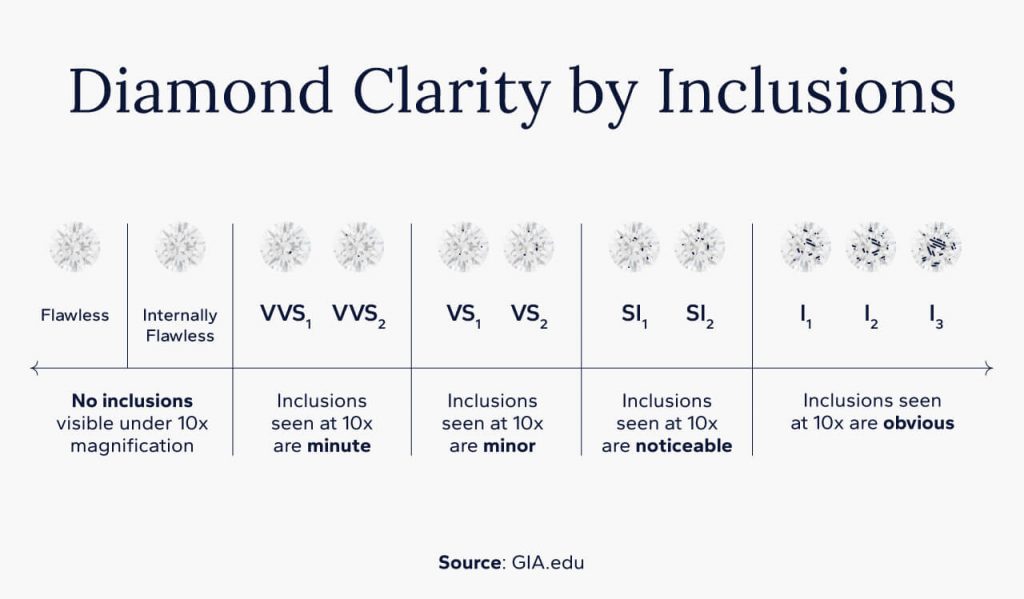
Diamond clarity is determined by the presence of internal features (inclusions) and surface features (blemishes). Evaluators look at inclusions under 10x magnification to assess their size, quantity, location, and type . The fewer and less visible the inclusions, the higher the clarity grade.
That said, higher clarity doesn’t always mean a more beautiful, timeless diamond. Many inclusions are too small to affect brilliance or be seen without magnification. An eye-clean included diamond in the VS (Very Slightly Included) or SI (Slightly Included) range can sparkle just as much as a flawless one, especially when expertly cut. Understanding which inclusions matter most can help you find the right balance of beauty and value.
How Inclusions Appear on a Diamond Grading Report
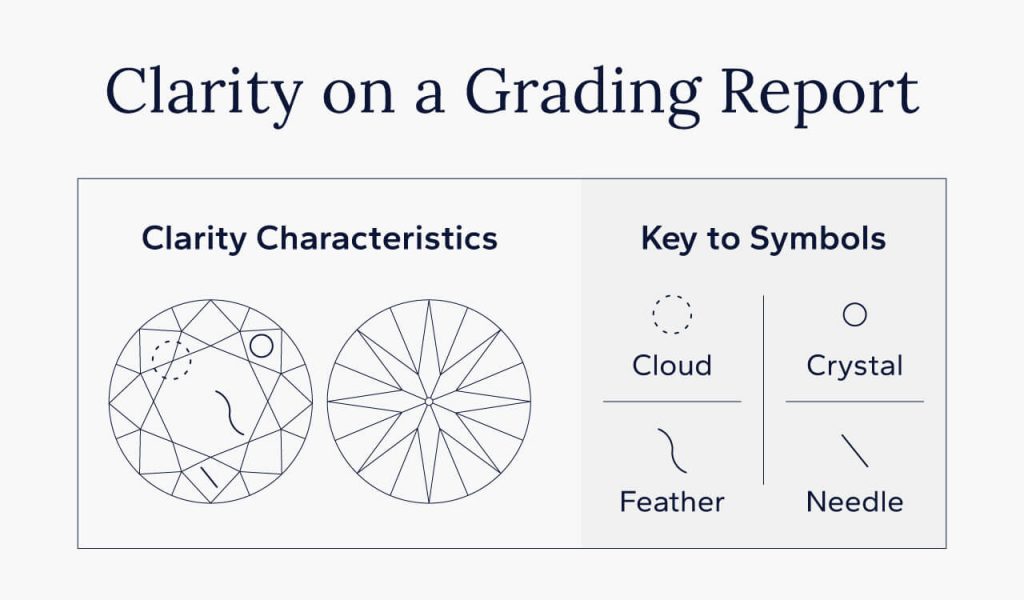
A diamond grading report includes a clarity plot, which is a visual map showing the type and location of inclusions.
Symbols represent different inclusion types (like feathers, crystals or clouds), allowing you to quickly understand what’s inside your stone. These symbols vary by grading lab, but most use standardized shapes and colors to differentiate between internal and external features.
It’s important to note that not every inclusion appears in the clarity plot. Minor features that don’t impact clarity or value may be omitted. For this reason, reading both the clarity plot and the written clarity grade gives you a deeper understanding of the diamond. A certified report, combined with expert guidance, helps you shop with confidence and know exactly what you’re getting.
How to Buy a Diamond with Inclusions
Buying an included diamond doesn’t mean sacrificing beauty. With the right guidance, you can choose a stone that offers incredible value while still appearing flawless to the naked eye. Here’s what to consider when it comes to diamond inclusions:
1. Prioritize an eye-clean appearance
The sweet spot for many shoppers is in the VS and SI clarity ranges. These diamonds often appear eye clean but cost significantly less than those with higher grades.
When evaluating clarity, always look at the diamond from the top. Inclusions off to the side or near the pavilion are less noticeable once the stone is set.
2. Consider durability and lifestyle
If you’re choosing a diamond for everyday wear, like an engagement ring, durability is essential. Some inclusions, such as feathers near the girdle or surface-reaching chips, can make a diamond more vulnerable to damage over time, especially with frequent impact.
For those with active lifestyles or hands-on jobs, shape matters too. Diamonds with sharp points, such as marquise or princess cuts, are more susceptible to chipping if inclusions are located near the edges. In these cases, it’s worth investing in higher clarity or choosing a more durable shape like round or cushion.
3. Use settings strategically
The right setting can go a long way in concealing visible inclusions. Prong settings can cover small inclusions near the girdle or edge without drawing attention to them.
Bezel and halo designs are also smart choices. A bezel encircles the diamond and can hide inclusions near the edge, while a halo adds extra sparkle and distracts the eye from minor clarity characteristics.
Get Clarity on Diamond Inclusions with Blue Nile
There’s something deeply satisfying about finding the perfect diamond: one that sparkles beautifully and fits your standards. Now that you know what to look for, the fun part begins.
Understanding diamond inclusions helps you choose with clarity, not compromise. With the right knowledge, you may find that inclusions can be a good thing and add character to your stone.
Ready to start your search? Explore Blue Nile’s loose diamonds and engagement rings, or connect with one of our trusted diamond experts to find a piece crafted to mark your moment and last a lifetime.
Frequently Asked Questions
Yes, nearly all diamonds, whether natural or lab-grown, contain inclusions. These internal features form during the crystal growth process and help gemologists identify and grade each stone.
Certain inclusions, like large clouds or poorly placed feathers, can slightly reduce a diamond’s brilliance. However, most inclusions are too small to impact light performance.
Some surface-reaching inclusions, such as feathers or chips, can become more pronounced if the diamond is exposed to frequent impact. With proper care, most inclusions remain stable.
Yes, settings like prongs, bezels or halo designs can conceal visible inclusions, especially when they’re located near the edge. Choosing the right setting is a smart way to maximize clarity without upgrading the diamond.
While lab-grown diamonds often contain different types of inclusions, both lab-created and natural diamonds can have visible or invisible clarity features. Each stone should be evaluated individually.
Sometimes, laser drilling or fracture filling can reduce the appearance of certain inclusions. The gemologist must always disclose and note these treatments on the grading report.
Certain inclusions, particularly feathers or cavities near the girdle, can weaken a diamond if they reach the surface. Most inclusions, however, are internal and don’t affect durability.
No. Avoiding all inclusions limits you to FL/IF diamonds costing 40-60% more than VS grades with no visible difference. Most inclusions are harmless and invisible. The goal is finding eye-clean diamonds with well-positioned inclusions, not avoiding them entirely.
Once formed and cut, a diamond will not develop new inclusions. The stone’s internal characteristics remain stable and permanent under normal wear conditions.


Share